Naked Pursuit of the Wolves
Never Cry WolfNaked Pursuit of the Wolves is a comic reversal in Farley Mowat’s field observations: chasing three wolves across the ridges, he expects to witness a hunt, but instead frightens the animals and sets the caribou running himself. The episode turns his own impatience into evidence, showing how easily a human observer can mistake expectation for what is actually happening in the field.
The Pursuit Begins
The incident took place during a visit to a small camp belonging to Ootek’s community. Ootek had introduced Farley Mowat to a family there, and the group spent the afternoon talking, laughing, singing, drinking tea, and eating boiled caribou. The men had pitched their tent near a river crossing where caribou passed through a narrows; they planned to hunt there in kayaks with short spears, hoping to secure enough meat for the winter. Ootek wanted to join his friends, and Mowat agreed to remain at camp while they went hunting.
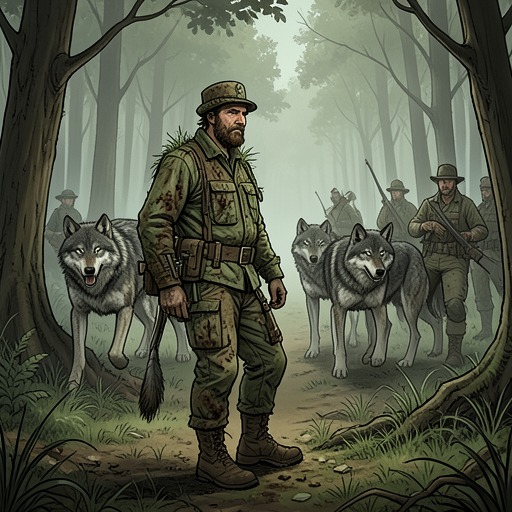
The season had turned: the flies were gone, and August brought hot, windless weather. Mowat went some distance from camp to swim and sun himself. From the ridge where he rested, he spotted three adult wolves crossing the next crest. One was white; the other two were almost black, an unusual color phase. One of the dark animals was smaller and lighter than the others, and Mowat thought it was probably female.
His clothes were by the shore, well away from the ridge. He judged that going back for them might cost him sight of the animals, so he took his binoculars and followed instead. The terrain made observation possible: low ridges overlooked grassy valleys, where small groups of caribou grazed. When the wolves passed out of view, Mowat could run to the next crest and watch them again from above. Excitement and exertion sharpened his expectation of a sudden attack. At the first ridge he reached, however, the scene below was quiet: about fifty male caribou grazed in small groups, while the wolves crossed the valley without provoking an obvious alarm.
What the Wolves Did—and What Mowat Did
The wolves did make repeated short rushes toward caribou, but the attempts ended quickly. In the hour Mowat watched, at least twelve rushes were directed at individual fawns, females with fawns, or groups of females and young. Each chase broke off almost as soon as it began. The pattern accorded with his later observations: wolves might test an animal with a brief dash, then stop and watch it flee. If a deer ran well and appeared in good condition, the wolves gave up rather than continue a pursuit they were unlikely to win.
Mowat, by contrast, had crossed miles of country and was frustrated by what seemed to him a failure to hunt. When the three wolves left one valley and went over a distant crest, he hurried after them, still expecting decisive action. He reached the crest and ran straight into the group, which had apparently paused to rest. The animals scattered in alarm. As they fled through the caribou, the herd finally stampeded—but the disturbance Mowat had been waiting to see was caused by his sudden arrival, not by the wolves. He recognized the source of the panic and abandoned the pursuit.
That reversal matters to the episode’s account of predation. Elsewhere, Mowat describes a recurring restraint in wolf hunting: the animals did not treat every nearby caribou as prey, and they often broke off when a healthy animal proved too fast to catch. His own intervention produced the dramatic flight he had mistakenly anticipated from the wolves. The scene therefore records not a successful hunt, but a failure of observation corrected by an unwelcome demonstration of the observer’s influence.
The Search Party at Camp
Some miles from camp, Mowat saw the woman from the family and her three children running toward him. They were shouting, and the woman carried a short snowknife while the children held hunting or skinning tools. Mowat then realized how he must appear: he was unarmed and had left his clothes by the water. Unsure why the family was advancing, he tried to pass them and ran back toward camp. The woman and children continued after him; he reached his trousers and rifle before they arrived, and the return of Ootek and the men prevented the encounter from becoming a confrontation.
Ootek later explained the alarm. One of the children had seen Mowat running across the hills after the wolves and reported what he had witnessed to his mother. She feared that Mowat had lost his senses and was attempting to attack a wolf pack without weapons, so she gathered the children and set out to rescue him. The misunderstanding arose from the same pursuit seen from two different positions: Mowat thought he was following animals, while the family, lacking that context, saw a person behaving in a way that appeared dangerous.
For the rest of the visit, the woman treated Mowat with a wary mixture of solicitude and distrust. Ootek’s dry observation as they paddled away made the social consequence plain: Mowat’s choice to leave his clothes behind had not helped his standing with her. The incident ended not with the expected wolf encounter but with an unnecessary rescue attempt and an awkward farewell.
Observation, Expectation, and Consequence
The episode sits within a longer education in watching Wolves without simply imposing familiar assumptions on them. Mowat had already learned that the open country made close observation difficult, and that sustained study depended on attention to behavior in context. His later observations of the wolves’ hunting reinforced the lesson visible here: a brief rush did not necessarily mean a sustained attack, and a stampede did not by itself prove that predators had driven the herd.
Ootek’s knowledge also shaped Mowat’s developing understanding, though the episode itself makes the family’s practical response—not a spoken lesson—the immediate counterpoint to his pursuit. The family was at the river to obtain caribou for winter, and the men’s hunting plans depended on knowing where the animals crossed. Mowat’s unexpected chase, meanwhile, produced a commotion without providing food or confirming the hunting scene he had hoped to observe.
The narrative’s reversal is deliberately concrete: the wolves flee, the caribou run, and the human observer discovers that he has supplied the missing cause. The brief comedy does not erase the field evidence. It makes the limits of observation part of that evidence, distinguishing what the animals did from what Mowat expected them to do, and what the family feared from what he believed he was doing.